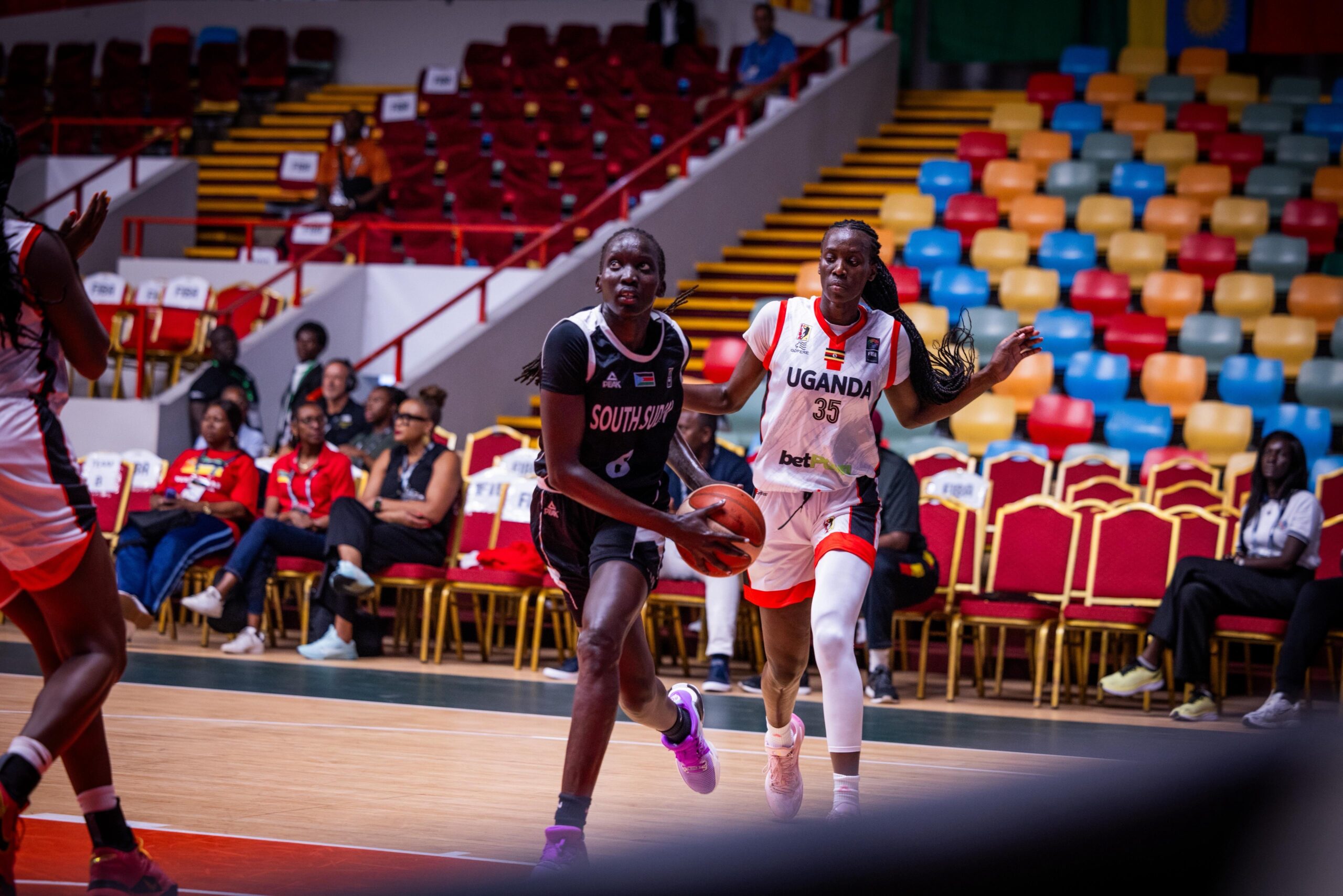


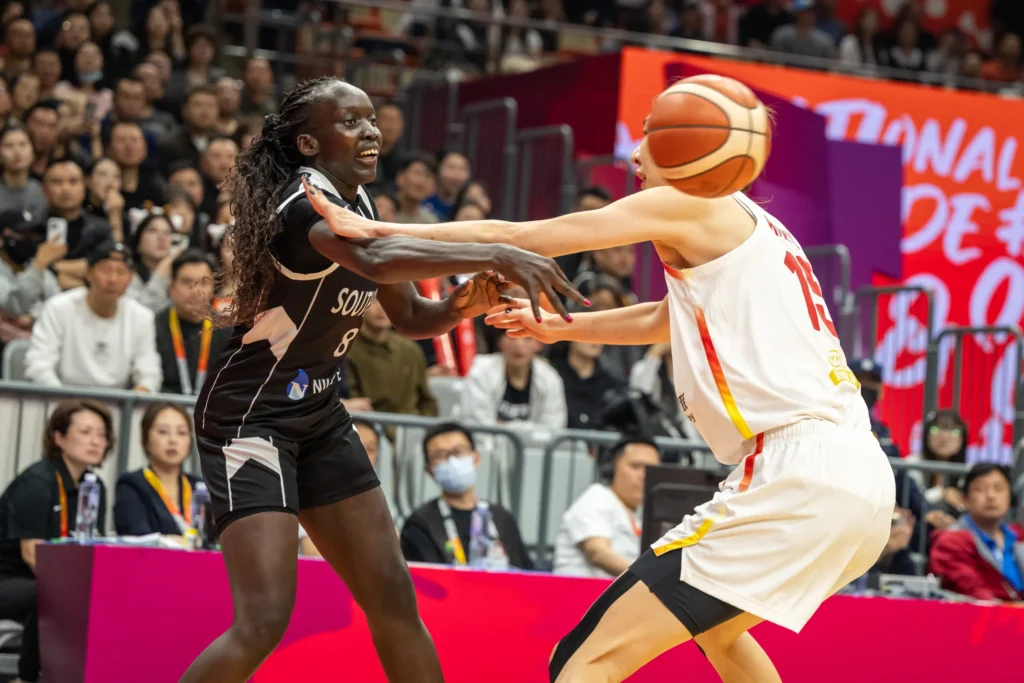
Rose Macuei had barely spent more than 35 hours in China when she played against the host country on Saturday evening. The 6’1” South Sudan forward finished the game with 4 points, shooting a perfect 2/2 at the free throw line and 3 steals. Due to delays in document processing, she had been unable to camp with the team in Wuhan on time. Yet one could barely tell the fatigue she carried as she paced up and down the court forcing turnovers and playing an impactful defense.
When one scrolls through the FIBA ranking of national teams, the South Sudan women’s basketball team’s position easily piques one’s interest. The team sits in the 55th position, midway through the 120-team table, indicating that it’s the lowest-ranked team at the ongoing Tournaments. However, it tops the Biggest Climbers table, with a +31 jump from the 86th position.
As South Sudan’s first game day drew closer, I reached out to Rose to find out how she felt about finally playing at this stage. She wasn’t in a position to express herself as she was still in Egypt waiting for her visa to be approved.
“I actually doubt I will watch our first game,” Rose stated. “I have a test to take.” She is currently pursuing a Master’s in Financial Accounting at Manipal University in India. She missed watching her teammates take on the Czech Republic in the opening game of the tournament.
A day later, Rose boarded Turkish Airlines at Cairo International Airport, and nine hours later, she landed at Kuala Lumpur International Airport for a 4-hour layover. She arrived in Wuhan on Friday morning at 10:00 am, in time for the game against the hosts.
Where it All Began
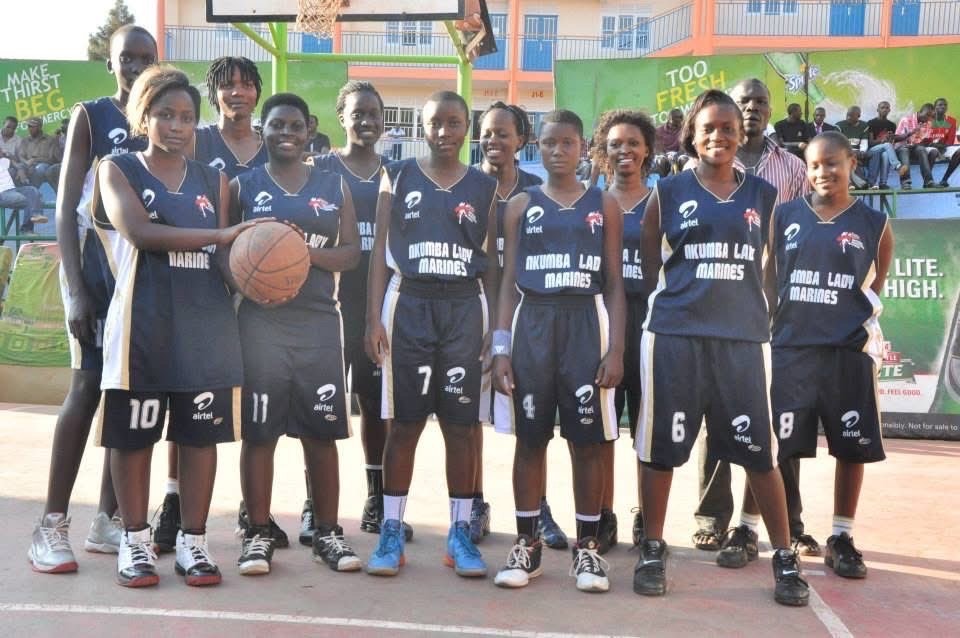
“My high school coach promised me that I would travel with the girls’ team for national games if I joined his practice sessions,” Rose responded when asked about her influence on playing basketball. Decades later, beyond traveling within the country for national games, Rose has traveled across the globe because of basketball. She has played in Rwanda, Portugal, France, Morocco, and currently plays for Al Ahly in the Egyptian Basketball Premiership League.
Rose’s journey started in South Sudan in April 2000. She is the third born of six siblings. “We are actually ten children. I have five siblings from my biological mother and four from my stepmother.”
With the uncertainty that lies in South Sudan caused by the constant wars that have marred the economy and cost the lives of many, Rose’s father decided to relocate his family to Uganda. At the age of seven, Rose recalls packing all their belongings and leaving their home in search of better opportunities in education, healthcare, and generally life in Uganda.
Choosing South Sudan
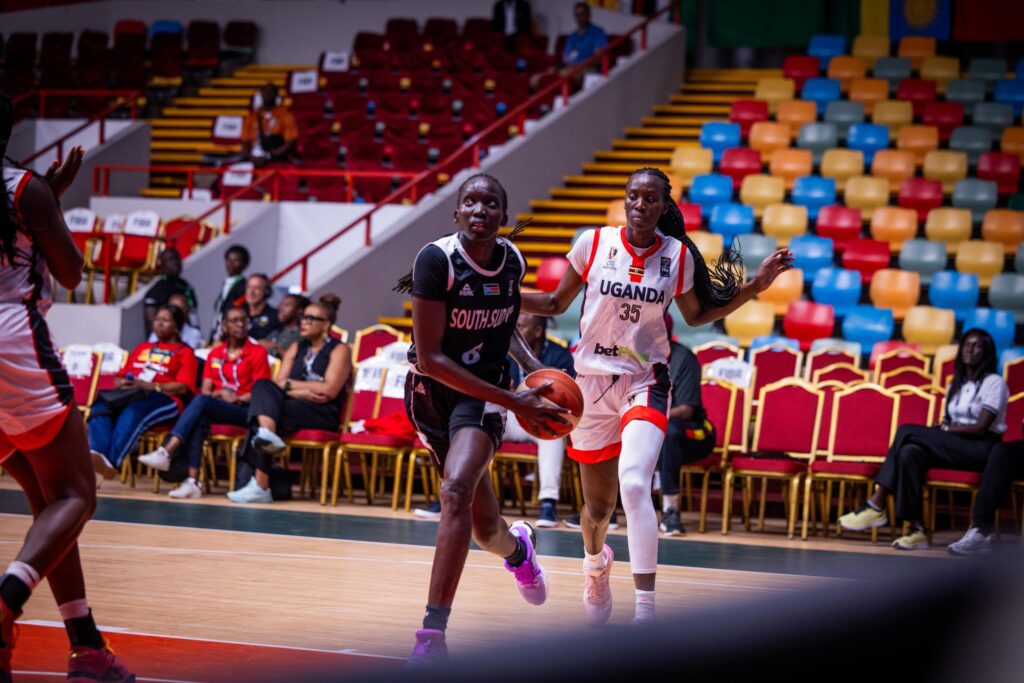
When teased about her decision to play for South Sudan over Uganda, Rose takes a deep breath, laughs a bit before she replies, “If I weren’t playing for South Sudan, I would be playing for Uganda. I owe a lot to Uganda because it is what made me who I am today.”
Rose’s decision to play for the South Sudan national team came loaded with doubts, worries, tough decisive moments, and inspiration from the two-time NBA All-Star, Luol Deng’s involvement with the South Sudan Basketball Federation. In 2021, as the first window for the FIBA Afrobasketball Qualifying tournament was set to take place in Kigali, Rwanda, Rose had a tough decision to make: either to naturalize and play for Uganda or to play for her home country, South Sudan.
“The first time I watched the SSD men’s national team playing in Nairobi, I knew that I wanted to play for South Sudan. There was this pride ignited in me. It was at the 2017 AfroBasket qualifiers, which took place in Kenya.”
Rose knew that beyond the pride, there was, in fact, barely any hope of ever playing for her country. South Sudan doesn’t have an active basketball league. So, how could the formation of a national team be justified? It was a pipe dream for the forward who was soon completing her undergraduate studies at Uganda Christian University.
“I approached Luol and boldly asked him if he would ever create a national team for the women. I knew that if the men could do this without an active league back home, why not us, the women?”
Loul was ecstatic about the idea of a women’s national team. However, the team’s main focus would be the South Sudan players in the diaspora. Rose would be an afterthought. Indeed, fast forward, today on the national team of SSD, Rose is the only African-born and lived athlete. The rest of the team comes from the USA, Canada, and Australia. The uncertainty in South Sudan turned most of their families into refugees at a young age, and through refugee camps, they sought asylum in their new home countries.
“I was preparing to play for Uganda. The Uganda Basketball Federation president had already started the process of my naturalization. My teammates from university were encouraging me to play for Uganda. I knew I would be valued playing for Uganda. After all, it’s Uganda that taught me basketball, and I played in the national league. Uganda knew my capabilities.”
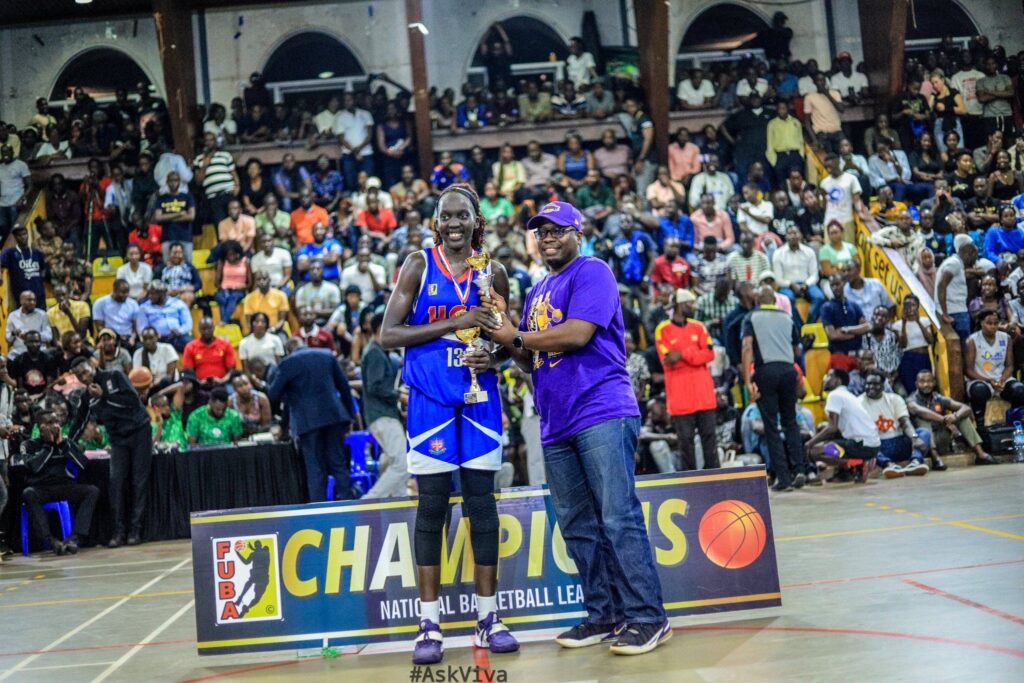
However, Rose’s decision came as a surprise to many. The South Sudan technical team made the national team call-ups. All the players called up were from the diaspora. To Rose’s dismay, she wasn’t called up on the grounds of having played basketball in Africa all her life. The technical team feared she would fail to measure up to the skill level and experience of the players from the diaspora.
“Unfortunately, one of the players at the camp tore her Achilles, and we are down to 11 players. We have printed out a jersey for you, and we would like you to come join us,” the voice on the other end of the call said to Rose.
The games were less than a day away, and she had not camped with the rest of the team. Within no time, Rose was at Entebbe International Airport for her flight to Rwanda. But her woes were not over; she tested positive for COVID and couldn’t fly.
“I took over a week to heal from this.”
As she reflects on her journey to the national team, what started as a doubtful journey has become a rewarding one for the 26-year-old.
“When my teammates learned that I was struggling to get my visa documents to travel for this tournament in China, they all reached out with great concern.”
Rose has become an impact player for the South Sudan women’s national team. During the FIBA Afrobasketball games in Egypt last year, she played a huge role in South Sudan’s victory to secure third place and qualification to this tournament. The defining moments for the team were beating the top-seeded teams like Senegal and Uganda.
More than a Game
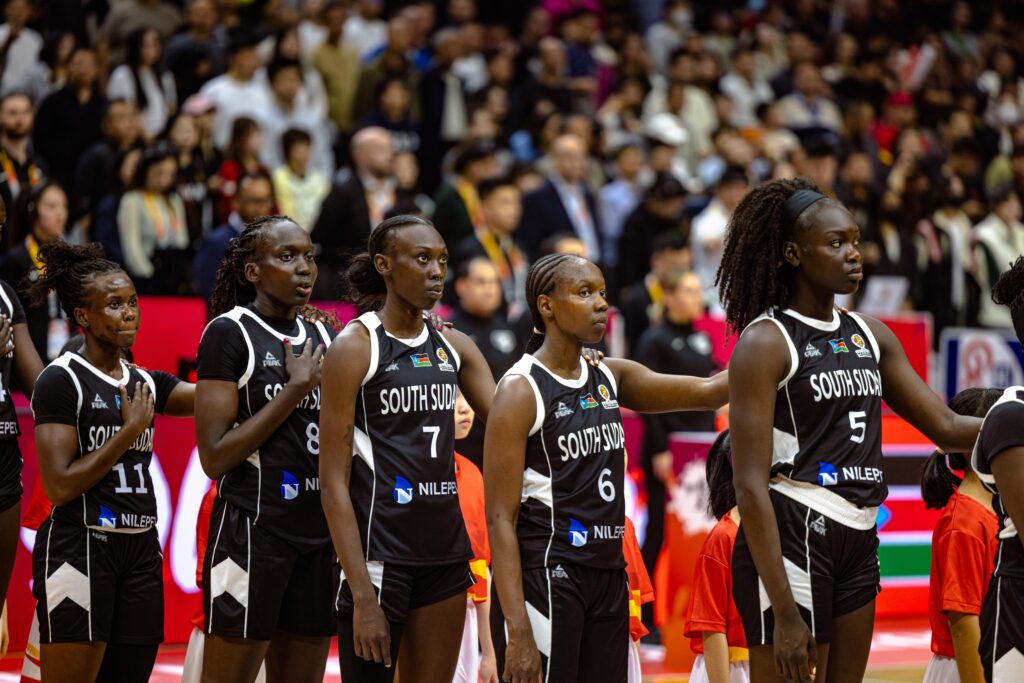
“It is more than just basketball,” Rose replied when asked about what basketball means for South Sudan. “Year after year, no good news comes from South Sudan. Competing at the FIBA Women’s World Cup Basketball is a reflection of hope and a beam of light in the dark tunnel. Even if we are not winning, at least we are putting the country in the media for the right reasons.”
Currently, South Sudan is undergoing high political tensions, which have once again put many people’s lives at risk. As February came to an end this year, 169 people were reported dead following a clash between the country’s army and a militia opposition rebel group. The UN reported having over 1000 people in displacement camps following the attacks. Areas of service, such as hospitals, have also been targeted heavily by the rebels, leaving lots of damaged property and deaths.
“When all is not going well, but you hear something good about your country, it gives you some pride and puts a smile on your face.”
Her response radiates the excitement that was shared across the globe in 2024 at the Paris Olympics exhibition game when the men’s national team nearly upset the USA. For the first time, everyone was tweeting, posting, blogging, and chatting about South Sudan positively.
What Playing at the Tournament Means to Rose
“What does it mean to me?” She echoes the question. “It’s a legacy. It’s for the girls who will come after me. I want them to look at me and think to themselves, ‘If Rose did it, why can’t I do it?’ I want to be an inspiration and a foundation. When they think of what hard work and resilience mean, I want the girls after me to think about my story.”
Rose sits deeply in thought at Kuala Lumpur International Airport in Malaysia as she awaits her next flight out to Wuhan, to join her teammates.
It has been a long way coming for the forward. Her journey from running away from instability, to landing a scholarship opportunity at Uganda Christian University, to securing her first professional athlete contract in Morocco, to traveling overseas is nothing short of commitment, self-belief, determination, and a strong will.
The Future
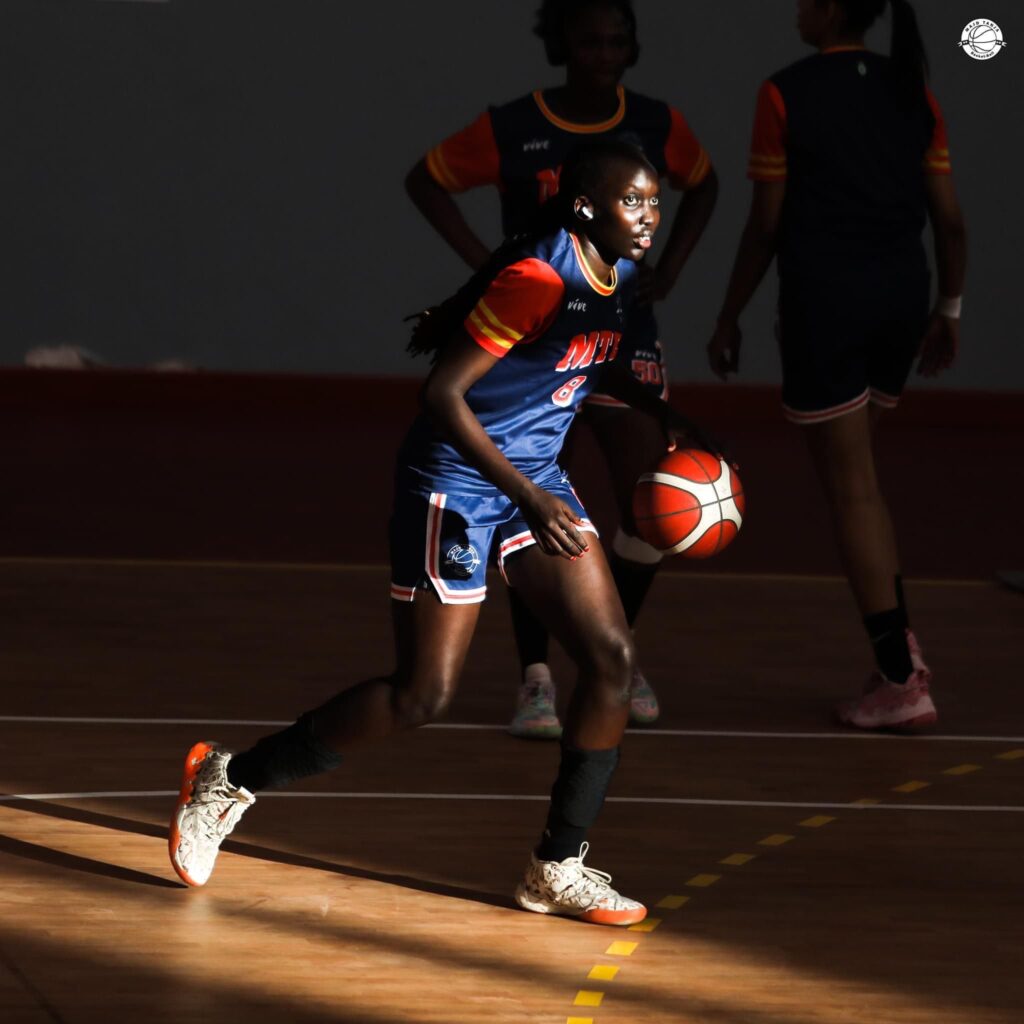
Rose dreams of setting up infrastructure and systems to support, mentor, and equip girls with skill sets to thrive in the basketball world.
“I want to get as many girls involved in basketball as I can.”
With every minute Rose spends on the court, she wears the South Sudanese jersey with pride.
As the national anthem plays before the game starts, she stands with her head held high and her hand at her chest as if to feel her heart beating to the rhythm of the anthem.
Representing your country at one of the highest levels competitively is every athlete’s dream. For Rose, it was a pipe dream that came to realization, and she now seeks to pave the way for more girls on the African continent to make it. She finished the tournament with an average of 9.3 points per game, 6 rebounds, and 2 assists.
South Sudan may not have had the best run at the games, but its presence at the tournament is a definition of hope. For a team that was founded in 2021, played as an underdog at the Zone 5 FIBA AfroBasket in 2025 to secure a wildcard to the AfroBasket games in Egypt, and make it to this level, it’s a story to look upon admiringly. The future looks bright for the South Sudan youngsters.
We celebrate all the women who played at the FIBA Women’s World Cup Qualifying Tournaments, and whose stories remain untold but inspire generations and the people they cross paths with.
Want to read more stories like this? Kindly subscribe to my blog. Big Foot Athletes is diversifying its content beyond the sports field to share lived experiences. Sports and charity will remain central to the blog’s content, but awareness and lifestyle have joined the conversation.
My book, Once I Arrived, will be out this year. It’s time you got lost in a book that tells you about the way of life in Uganda and in the USA through stories. I am excited about getting this book to your shelf.