

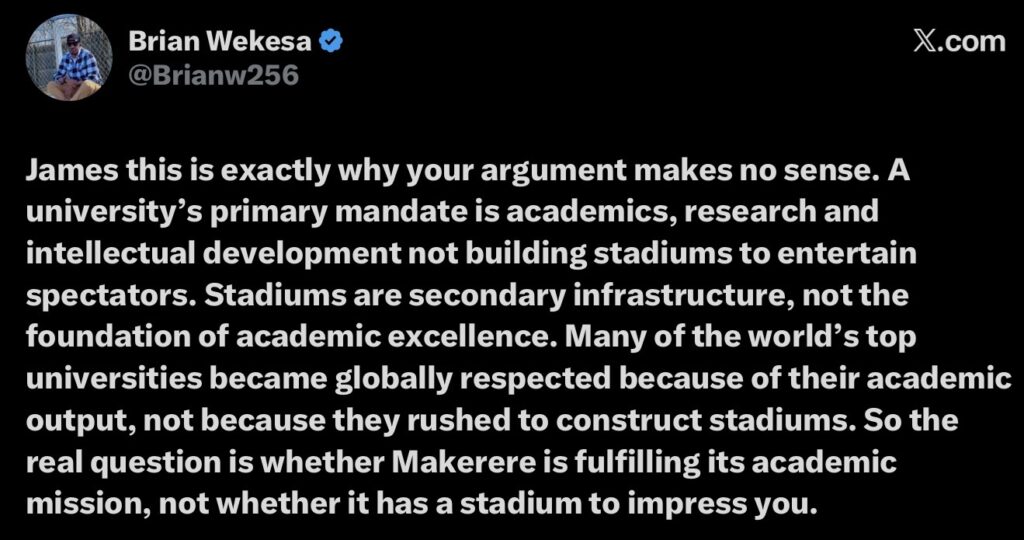
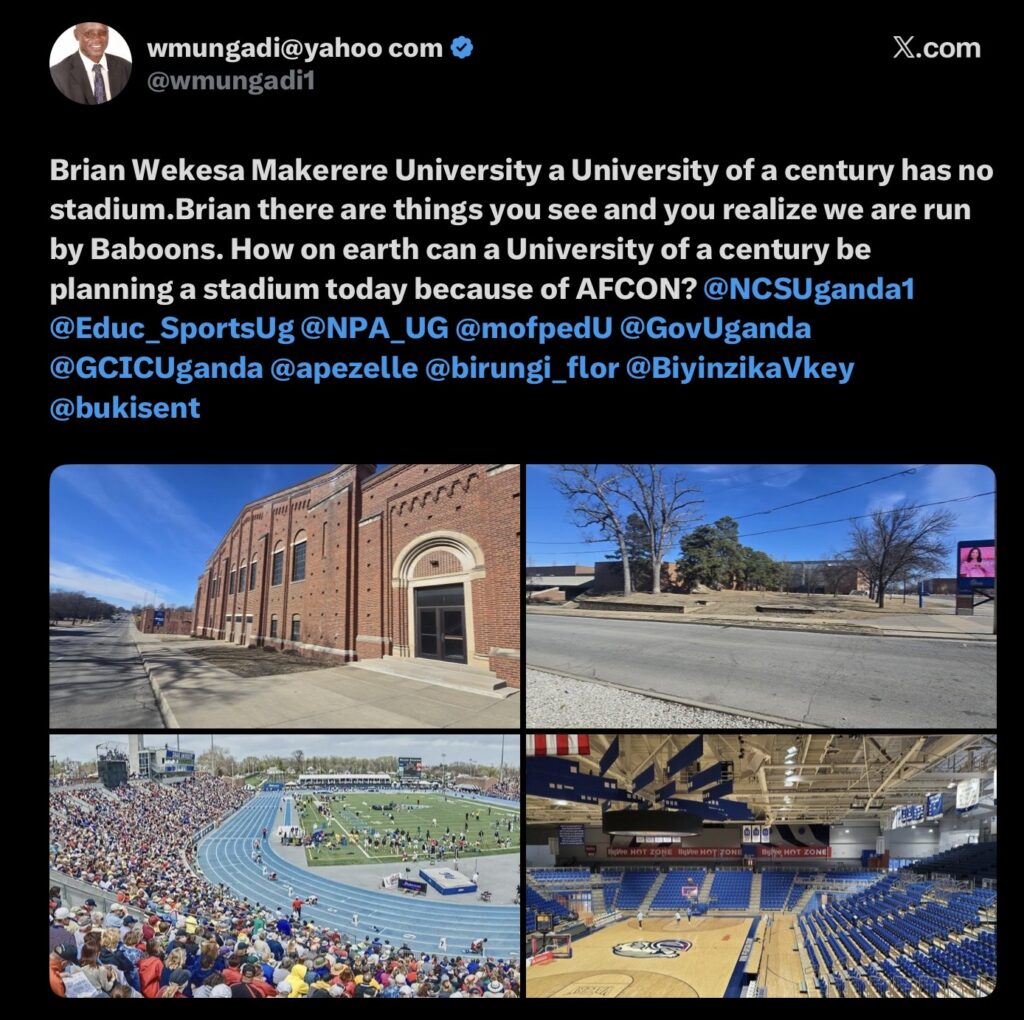
Recently, I came across a tweet by Brian Wekesa stating, “…A university’s primary mandate is academics, research, and intellectual development, not building stadiums to entertain spectators…” Brian was responding to a post by a concerned Ugandan, Mungadi, about the lack of proper sports infrastructure at one of Africa’s biggest and oldest institutions. The institution in the argument was Makerere University, a space that has produced most of Africa’s elite class. A continued back-and-forth discussion about this issue ensued.
Background story to Mungadi’s disappointment. Uganda is set to (co)host the 2027 AFCON games alongside other East African countries, Kenya and Tanzania. With this set to take place, Uganda needs to avail CAF certified playgrounds for games and practice. Hence, the establishment of grounds like the Hoima Stadium, which will host games. Makerere sports grounds will be a practice ground for the teams. In pursuit of making Makerere grounds CAF certified, the Uganda Army (UPDF) was granted the mandate to transform the grounds using UGX 21.8 billion into a world-class sports facility. Mungadi’s disappointment was rooted in the fact that Makerere University has existed for over 100+ years, but with nothing to show infrastructurally in the sports department. This was in comparison to other academic giant institutions like Harvard, Princeton, Penn State, name them all.
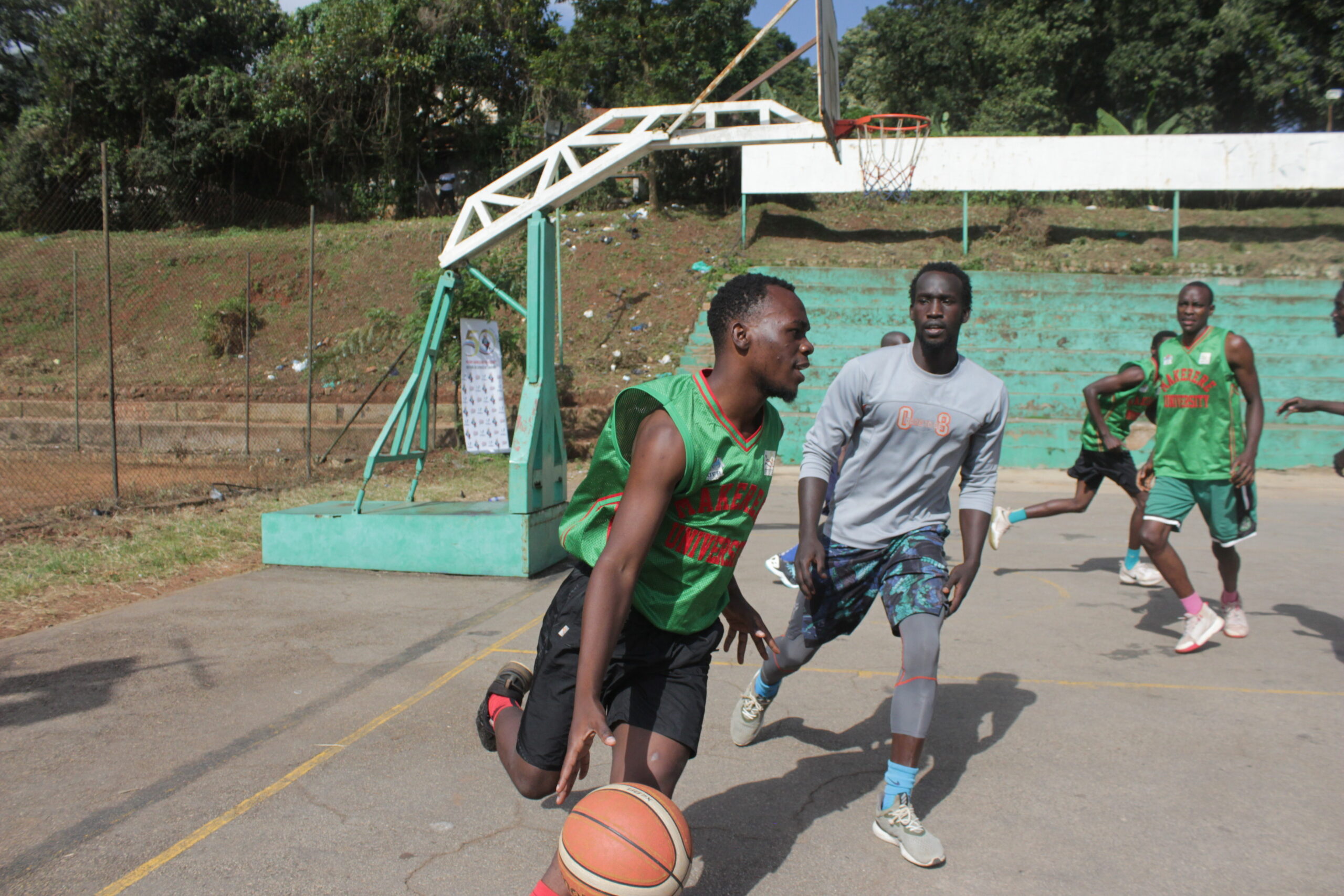
When I got a short playing stint with Makerere University, I was equally shocked about the challenges we had to shoulder as athletes. First, we had one basketball court used for practice and game day. The University has two outdoor basketball courts, but one (pool court) was “kidnapped” by the community and turned into a pickup spot. This left the women’s and men’s teams with one court (the main grounds). On some days, we begrudgingly shared half-half, and if a man mistakenly forgot to check his practice day, he would arrive at the court and bounce as the women were using it (and vice versa). In addition to sharing the court as the men’s and women’s teams, we had to share it with other teams such as Ndejje, Our Saviour (no longer in existence), Magic Stormers, Duhaga (also no longer in existence), Makerere College School (MACOS), and inter-hall competitions. This meant that as a university athlete, you didn’t have priority to use sports facilities.
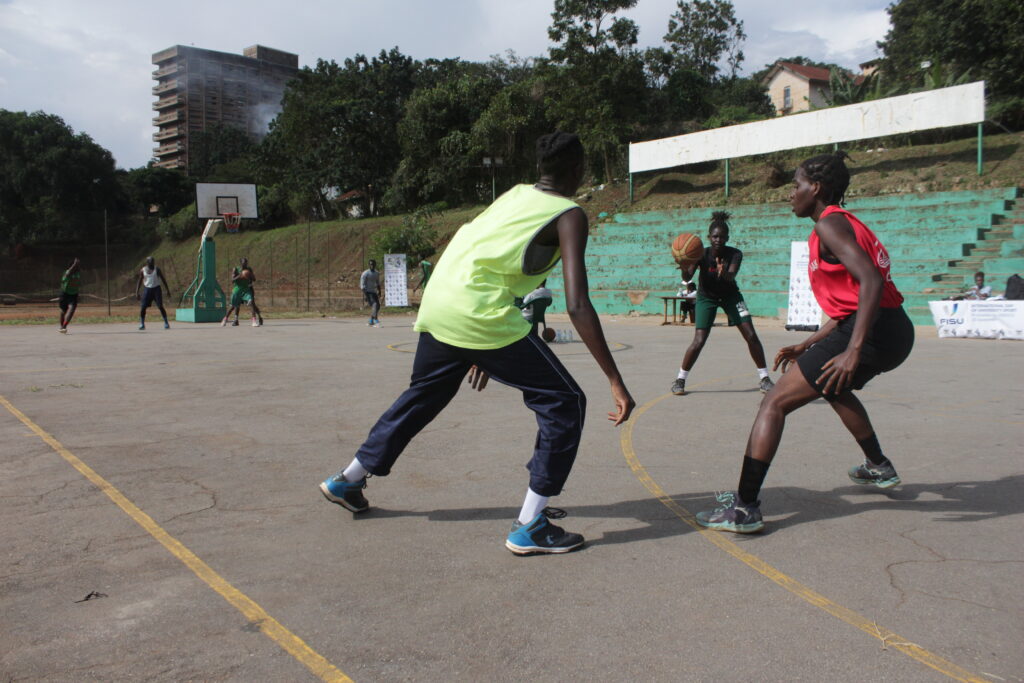
Let’s rest the sharing case. When it rained, it poured. On game days, we had torn mattresses and rubber squeegees on standby in case it rained. The ground was heavily dented and uneven, hence collecting puddles of water on a rainy day. When it wasn’t raining, the hoops were bent at an angle that even a 5 ft person could dunk. Having nets on the hoops was a dream for us.
All this sounds like we were in the 1950’s, right? Unfortunately, I am sorry to disappoint you, this was in the 2020s (21 – 22). But with all this, what baffled me the most was the lack of sports scholarships (not from the government) but from the university. Indeed, it wasn’t a surprise to see how the university performed against other universities that prioritized or offered such incentives to athletes like Uganda Christian University and Victoria University.
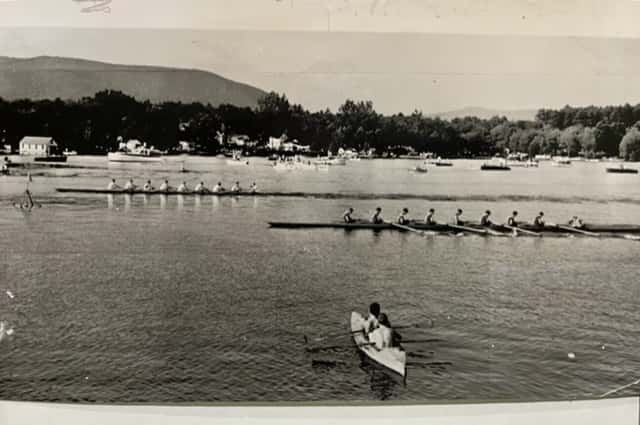
When I read Brian Wekesa’s comment, I nodded my head and laughed at his innocent reasoning. When I was in Uganda, I thought I had a pretty good understanding of the USA sports industry. But when I arrived in the USA, I realized I knew just a pinch of it. Sports and education are inseparable in the USA. Some of the colleges that one would have in question are the top universities like Harvard, Penn, Brown, among other Ivy league schools. Surprise, surprise: the first recorded college games took place between Harvard and Yale in a boat rowing competition in the 1850s. This event is what actually led to the start of the growth of college sports. Years later, in the early 1900’s, American football gained popularity among college students. However, the game was highly unregulated, and in the year 1905, there were 18 deaths and over 100 serious injuries (on record).
More surprises lie ahead. Guess who called for the meeting seeking ways to improve the playing field for college football players? President Theodore Roosevelt, the 26th president of the United States of America, called for the meeting. I won’t ask you to guess the attendees, but once again, surprise – some of the college presidents in attendance were from Harvard, Yale, and Princeton. This is what led to the formation of what we call the NCAA (National Collegiate Athletic Association). It was called the Intercollegiate Athletic Association of the United States at the time of formation.
I won’t bother you with any more history, but we can all attest to the success of college/university sports in the USA today. Side note: University and college mean the same thing in the USA. But college is used more. Currently, the NCAA has over 1,100 member schools across Division I, II, and III. Sports remain an integral part of any academic program in the USA. In fact, it has become a measuring rod for success for most colleges. Sports infrastructure is at the core of most institutions. Even the smallest colleges have standard sports grounds for different games, ranging from baseball, softball,basketball, American football, among others. A lot of land and funding is dedicated to the establishment of world class facilities at top universities.
Take an example of my current university, North Dakota State University; its pride is in the Fargodome. A 18000+ seater dome for football games, which has seen the university scoop 10 national football championships. Interestingly, the school has been faced with the talk from the community over, “The games are boring,” because the team has grown to outcompete its division mates. Each game felt like a practice session for the Bisons (NDSU football team). And yet most skeptics maintained the argument that “Our sports facility doesn’t meet NCAA standards to enable the team to move to a more competitive division.”
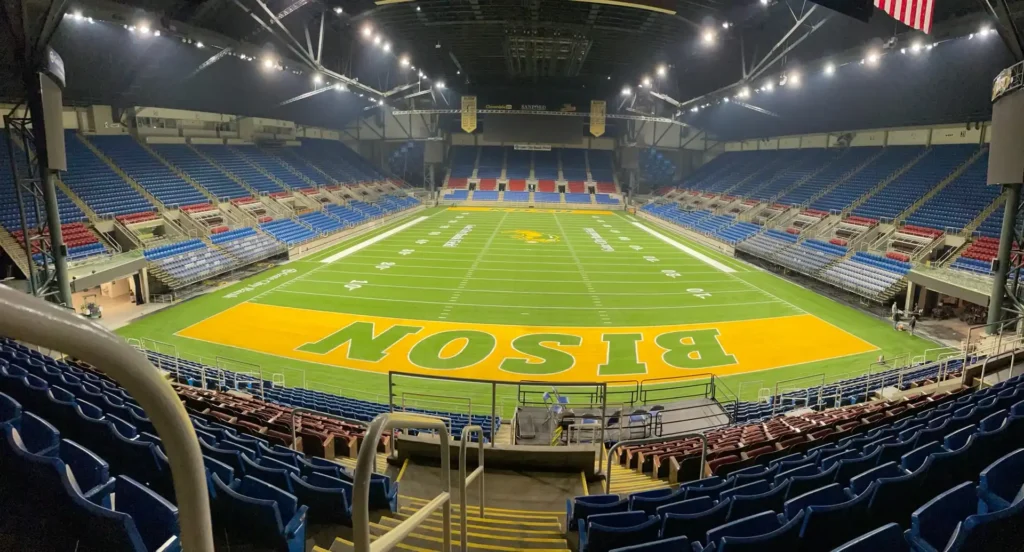
Did you catch that? “Our facility…” For emphasis, this is a 18000+ seater, well-managed and maintained space that cost $48 million to establish. Keep in mind – NDSU is a nationwide Research 1 recognized institution (this means it is a doctoral granting institution with very high research activity). In fact, I have met a Makerere University Professor at the institution, and I bet he would narrate better how sports infrastructure is part of every college’s development plan. Sports and education are in bed together and can’t be separated. Probably, we fail to understand why the Ugandan education ministry is called the Ministry of Education and Sports.
More so, Makerere University offers a three-year Bachelor of Sports Science Program. Hence, the establishment of functional and world-class sports facilities should not have waited this long.
Fun Fact: At every university, the President and the Chancellors are top-tier salary earners, followed by football coaches (at some institutions, basketball coaches).
For clarification, in the USA, the head of the university is the President, unlike the British system, where the head of day-to-day operations is the Vice Chancellor.
Thank you for reading this far. I am currently running a campaign to support special needs mothers, a group of women with children on the autistic spectrum. Your support will help the mothers afford basic needs like medical support for their children, food, clothes, and day to day expenses. You can read the full article here. I have also attached the poster. You can scan the QR code to read more about this. Thank you.